
The Royal Danish Theater: Tosca
– An Emotional Storm at the Opera
Fotograf: Miklos Szabo
✮✮✮✮✮
' …… This emotional storm is highly recommended ……'
– Bo Christiansen, KULTURINFORMATION
Puccini's opera Tosca is a popular and intense drama, a tight story with many layers. Emotionally, spiritually, morally, politically, socially, poetically, psychologically. There is something for everyone in this drama. Major themes such as love – romantic as well as the love of art, how those in power (and the church) fight against ideals of freedom, and then there are desire and jealousy, faith, hope, despair.
The Royal Danish Theatre is currently performing this emotional storm at the Opera, staged by Kasper Holten. In the performance I attended, Lukas Beikircher was the musical director.
Historical setting
Puccini's operas are naturalistic. We meet realistic characters with strong emotions who end up in fateful situations.
The story in Tosca takes place around the year 1800, when Napoleon's forces are approaching Rome. The revolutionary forces in Italy hope for France and Napoleon as liberators from an oppressive papacy and Ferdinand IV of Naples. With this framework as a backdrop, we follow the three main characters: Tosca: a passionate, jealous singer. She is at once strong and vulnerable.
Cavaradossi, her lover: a painter who sympathizes with France and Napoleon. He is the hero of the play, human and sensitive. And loyal. Even under torture and the threat of death, he does not betray his friends. And finally Scarpia, the police chief, who represents the power and the law. He is corrupt and brutal. He desires Tosca and wants to crush Cavaradossi.
Fotograf: Miklos Szabo
Visual framework
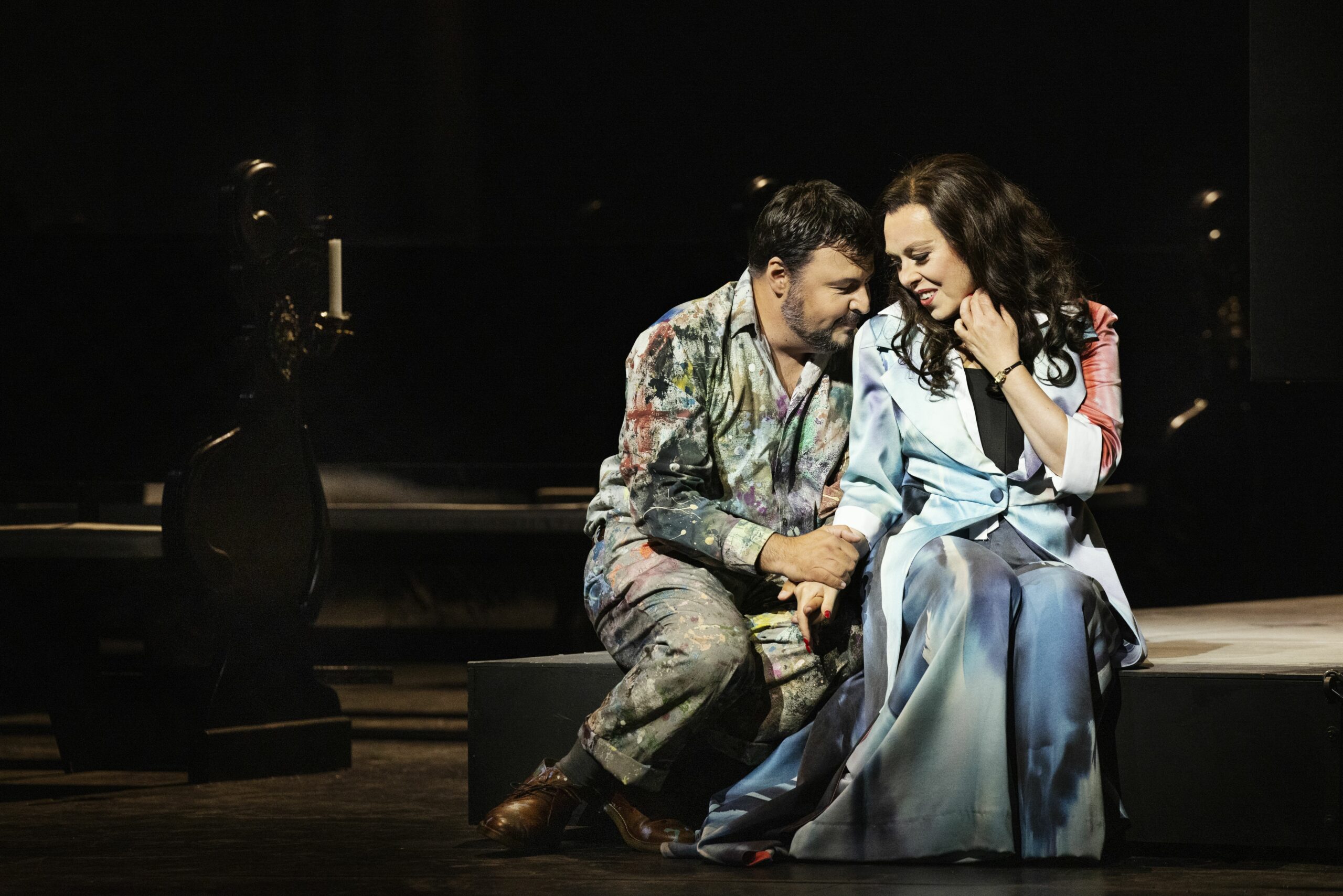
Philipp Fürhofer's set design contributes to the historical atmosphere and the costumes highlight the characters' personalities. Scarpia is dressed in white, as a strong contrast to his brutal and corrupt nature. Cavaradossi appears as a hard-working artist with paint splatters everywhere, supplemented in the second act with blood, and Tosca herself is in full regalia as a performing singer.
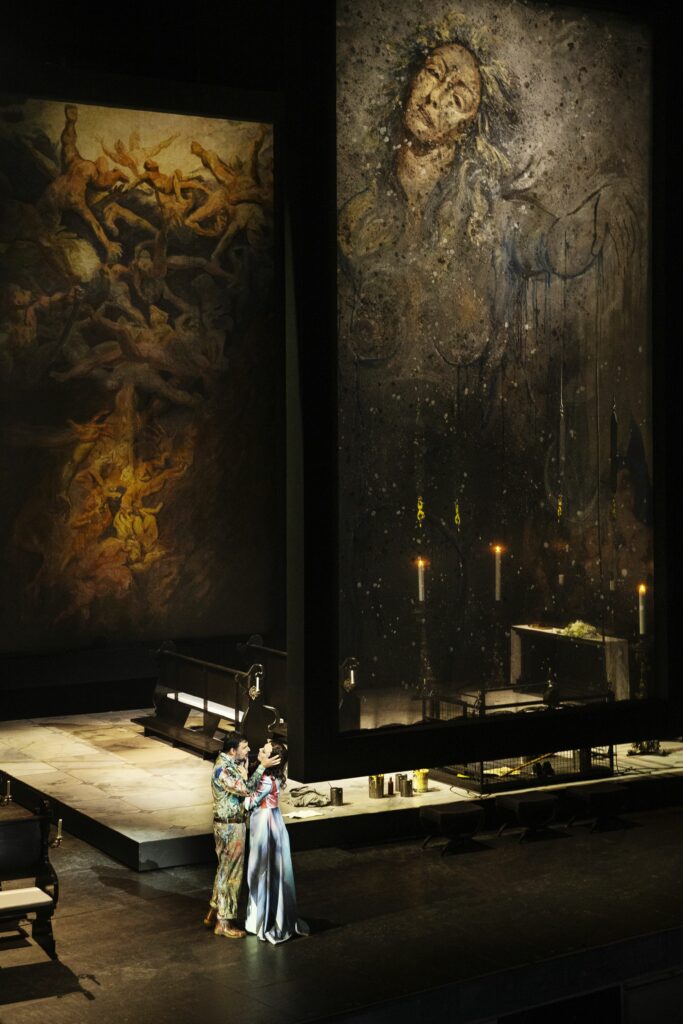
The scenes are simple and convincing, built with very few props and with enormous paintings as supporting elements. In the first act we are in the church of Sant’Andrea della Valle, where Caravadossi is working on a large painting of Mary Magdalene. Here we also meet Tosca, who is immediately struck with jealousy at the sight of the painting and the thought of the woman who must be the model. Scarpia and his men appear in pursuit of revolutionaries, and immediately suspect the two of them.
In the second act we are at Palazzo Farnese, where Tosca is to sing for the Queen, on the occasion of the French troops being repulsed. The palace is also Scarpia’s headquarters, where Cavaradossi is interrogated and tortured. The stage is elegantly divided into two floors, with the Queen’s room at the top, marked by a classical ceiling painting, and the darkness of the torture cellar just one flight down. Heaven and Hell.
Here Tosca is forced to witness the torture of her lover, and to negotiate with Scarpia. He offers Cavaradossi’s life in exchange for her body. Tosca gives in, but then kills Scarpia.
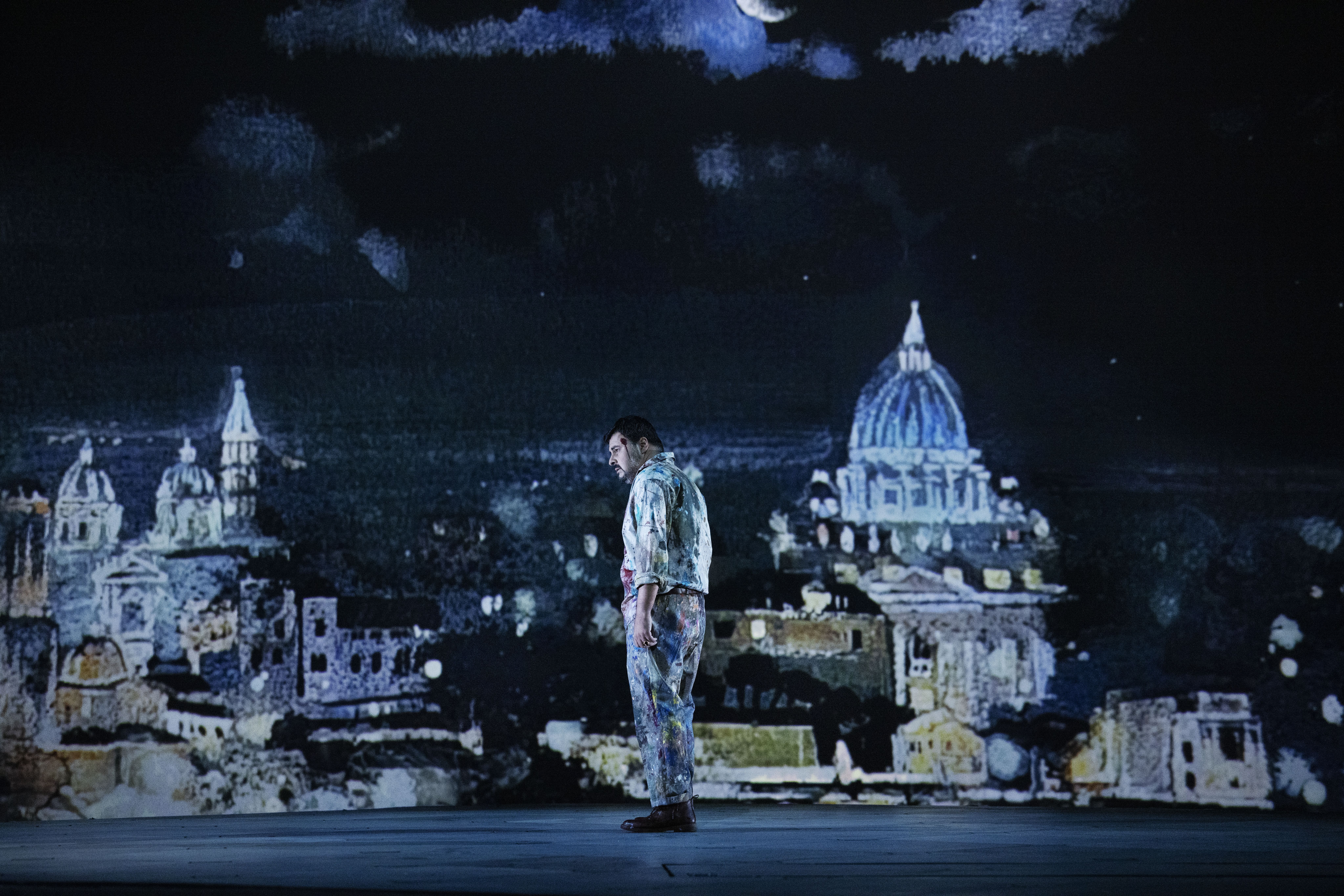
The third act takes place on the roof of the Castel Sant'Angelo prison, where Cavaradossi spends a long night while awaiting his execution. From here we have a view of Rome at night, while we in horror watch the dawn come in a fantastically beautiful animation. And no, we are not allowed to take pictures.
Shortly before dawn, a poignant duet follows, in which the two lovers share their hope for the escape Scarpia promised them. A promise he of course does not keep.
In most productions, Tosca commits suicide when she discovers that Cavaradossi will be executed anyway. But this production surprises, although not exactly with a happy ending. But precisely by not ending completely, the whole story is brought up to our time. There are still plenty of Toscas out there who have lived for art and for love, and who suffer.
The singers' performances
The roles in Tosca require both vocal strength and convincing drama. Marigona Qerkezi as Tosca exudes strength, but perhaps not quite the vulnerability the role demands. Her great aria “Vissi d’arte” is the moment when we truly meet Tosca, caught between love, faith and despair.
Carlos Cardoso, a warm lyric tenor, unfolds as Cavaradossi, both in the opening “Recondita armonia” and in “E lucevan le stelle”, where he expresses both resignation and sorrow.
As Scarpia, Johan Reuter has both strength and depth. The character must both charm and manipulate, at the same time with the brutal undertone of power constantly present. In “Te Deum”, religious assumed piety is drowned out by Scarpia’s desire for Tosca and his urge to get a hold of Cavaradossi.
Musical performance
The music supports the action with an almost cinematic intensity. In fact, Puccini's musical narrative technique has greatly inspired the way film music is made.
There is close interaction between orchestra and song, the orchestra supports the psychological game and thus reflects the characters' emotions. Every time Scarpia is nearby, dark harmonies sound. In the second act's duet, Tosca's prayer and impotence alternate dramatically with Scarpia's brutal power.
The libretto
The lyrics to the songs can be followed in both Danish and English translation above the stage. And several of the lyrics are worth meditating on.
In the first act's "Recondita armonia", Cavaradossi reflects on the beauty of two different women: the model he paints and his own beloved, Tosca. He praises the diversity of beauty.
In the second act, we have Tosca's "Vissi d'arte", her desperate prayer to God. She has lived for art and love – why must she suffer so much? The eternal question that is asked in numerous works of art.
And in the third act "E lucevan le stelle" where Cavaradossi prepares for his execution and meditates on the meaning of life. He remembers his love for Tosca and their lost happiness. Here we have one of the most famous arias in the history of opera – about resignation, passion and sorrow.
Fotograf: Miklos Szabo
Conclusion
Tosca is one of the most performed operas in the world. It is an opera that demands a lot from both artists and audiences. It is thought-provoking that great art such as opera, with singing, music, stage art – something that is often considered the most beautiful thing ever created – at the same time opens up the deepest instincts and darkest corners – revenge, jealousy, pride, evil. Tosca is a story about love and jealousy, about love of art, about power and desire, and about the choices people make under pressure.
This emotional storm is highly recommended. Come early. The Opera, both the surroundings by the water and the building itself deserve time for the initial immersion. The staff are good and discreet hosts. And the other opera guests contribute to the solemn atmosphere. Regardless of whether you are a beginner when it comes to opera, or you have seen other performances and versions of this opera, there is much to look forward to.
The Royal Danish Theater: Tosca – see more
The Royal Danish Theater: Tosca is a review by Master of Science, Bo Christiansen, KULTURINFORMATION
Redaktion: Jesper Hillestrøm