The North Atlantic House: MY FRIEND THE ART — Egill Sæbjörnsson
Art as your Friend
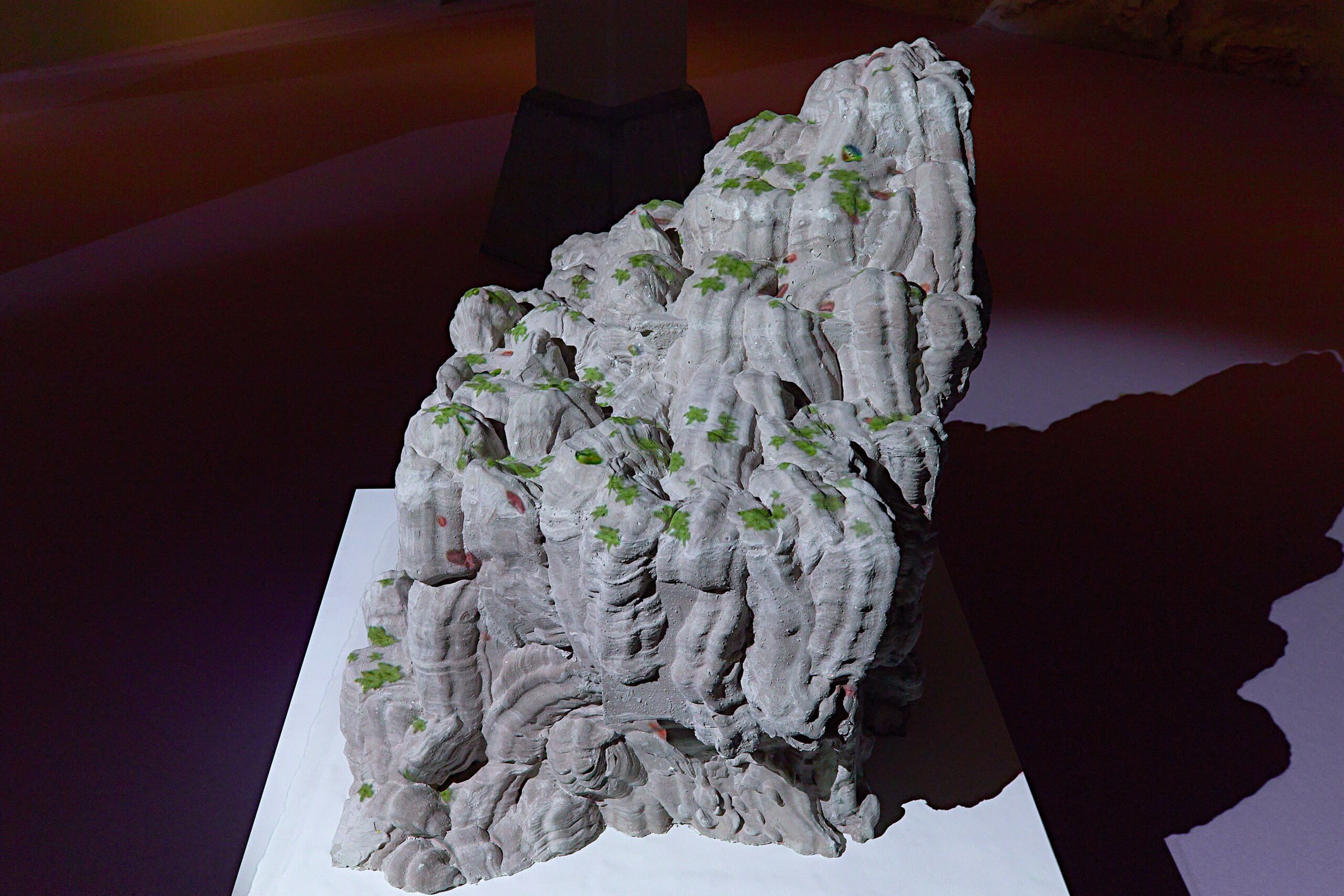
The big rock, 2025. Egill Saebjornsson. Photo, Chris Calmer
✮✮✮✮✮
' …… Art becomes a friend, we can interact with and ourselves be influenced by ….. '
– Master of Science, Bo Christiansen, KULTURINFORMATION
At Nordatlantens Brygge in a large old warehouse in rustic and atmospheric premises, there is a minimalist and philosophical exhibition of the works of the Icelandic artist Egill Sæbjörnsson running until the beginning of June 2026.
Egill Sæbjörnsson (b. 1973) lives and works in Berlin, Reykjavík and New York, and has exhibited in Sweden, Germany and other countries. But this is the first time he has had a solo exhibition here in Denmark.
The First Impression
The first thing is that you are asked to take off your shoes. Or put on coveralls. The floor is covered with a thin, delicate carpet. The exhibition is very sensual, and extends over two floors. Carpets, curtains, painted walls, the colors tie it all together.
On the ground floor there are some large, simple white plaster figures that are slowly and calmly caressed by light, shadows and colors. There are simple patterns in motion, insects crawling around or small openings that appear and disappear again. When you look at sculptures, time often stands still. But here time passes in a slow, meditative cycle. These sculptures are not installation art or mechanical mobiles. Projections of light creates the illusion of time passing and make the sculptures ‘alive’.
Art as a Friend
This idea is unfolded and explored in the exhibition. Art is seen as an independent, living being, a friend. Not just something we create, but something that is already inherent in the materials we work with when we create art. Something we can interact with, befriend and which is then allowed to influence us. And then suddenly we ourselves become something that ‘art’ also works with. The relationship between artist and artwork is played with.
This idea is not presented as a fully developed theory, more like an unfinished idea that we can work on ourselves. It is not a great new thought either. Many others have considered works of art, or their components, the very elements of nature, as animated.
The artist thus questions the oppositions of life and non-life, he abolishes the boundary between the two states and sees everything as variations of the same state, as continuous processes. In his own words, quoted from the catalogue: “Structures that arise, assemble, transform, disintegrate and reassemble.”
In this way, the artist attempts to do away with the traditional theory of evolution, without completely contradicting it. He does not begin with the first cell, the first life. He includes the geological and mineral processes that precede life as we know it. As well as the processes that continue after the end of life.
When the artist thus challenges deeply rooted, habitual notions, one almost owes him a debt of gratitude. So I do so:
I can easily follow the idea of art as something greater than just the individual work of art, as a force and not just some objects.
Something alive. But I probably have a simpler and more traditional way of understanding it: The world was created. By Someone. And this Creator is alive, conscious, possesses properties and qualities that we recognize from ourselves. Wisdom, a sense of order and beauty, joy in producing or creating, love for and the desire to interact with his work. Therefore, the world, nature, both the inanimate and the living, is a Work of Art. A Work of Creation. And the Creator's fingerprints and footprints are all over it.
That is nothing new either. The Apostle Paul wrote in Romans chapter 1, verse 20: "For the invisible things of him from the creation of the world are clearly seen, being understood by the things that are made, even his eternal power and Godhead; so that they are without excuse." (King James Version)
But Egill Sæbjörnsson doesn’t get so religious. Instead, he plays with the relationship between us and 'Art'. Art becomes a friend, we can interact with and ourselves be influenced by.
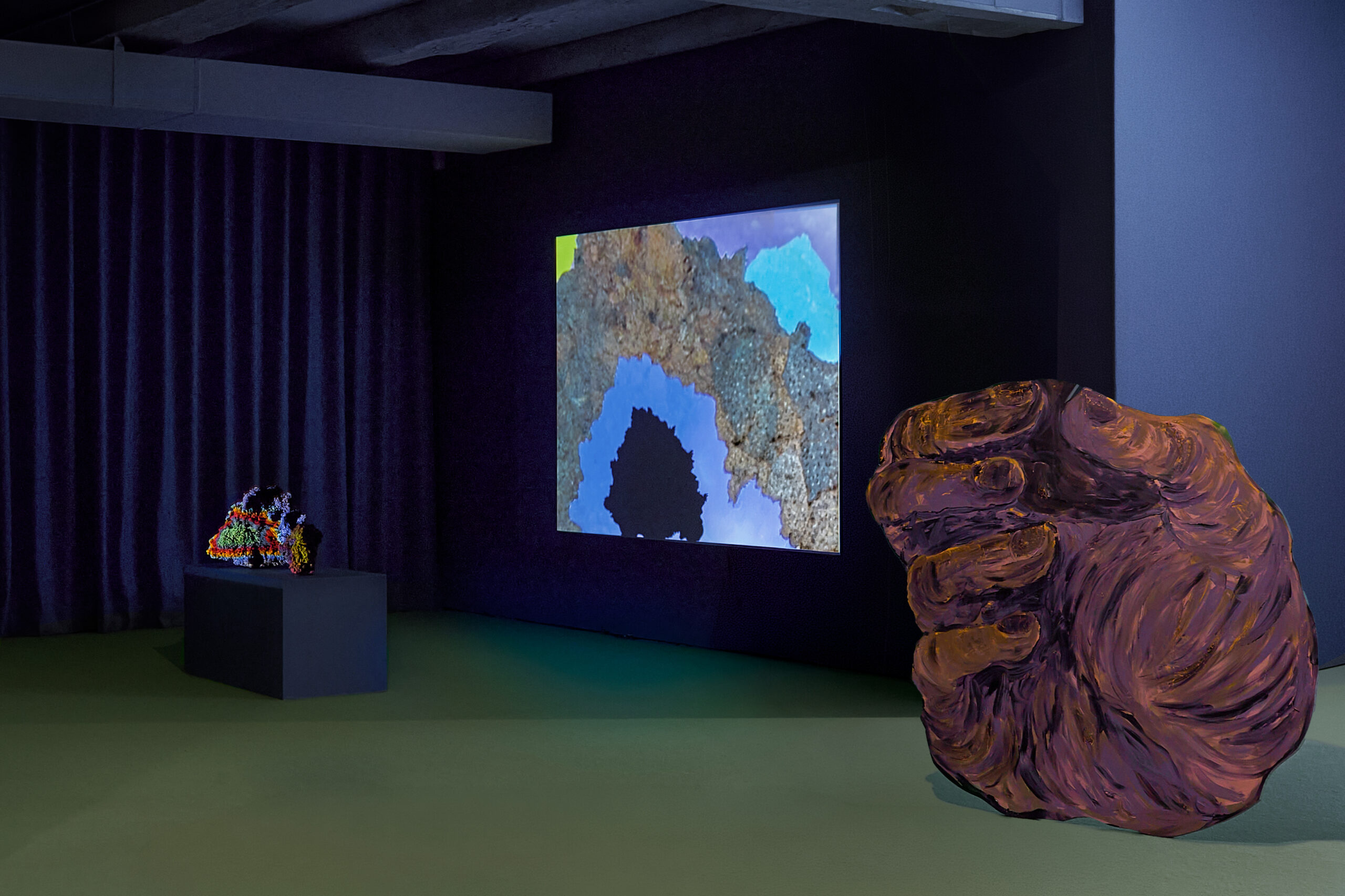
Big hand, 2026 & Pleasure stones, 2008. Egill Saebjornsson. Photo, Chris Calmer
Art as alive
This idea unfolds further in several of the works. In one place we see a stationary 'pencil', while the 'paper' or the screen moves, and flower figures are being created.
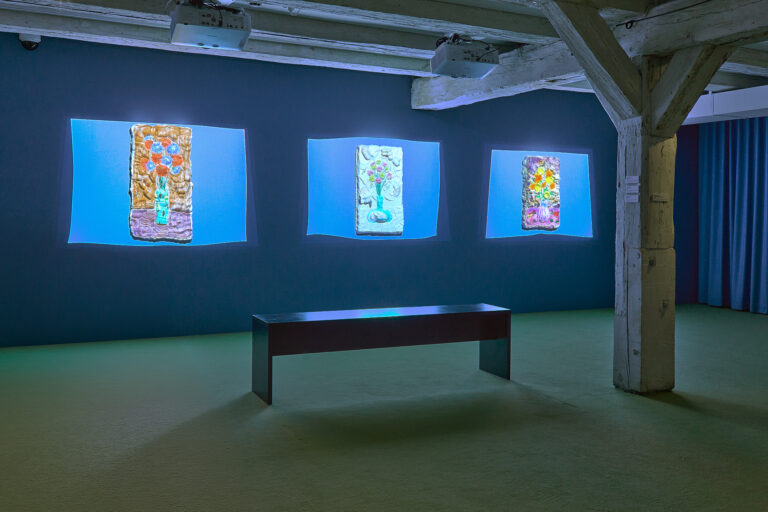
Or we can sit on a bench in front of three large rough plaster boards, and observe how the light slowly paints simple motifs of vases with brightly colored flowers.
And then the exhibition invites us to start drawing ourselves. On a table are presented some huge and unwieldy wax crayons. Left by some of the artist's invisible friends, some huge trolls. Very Icelandic.
The sensuality is exaggerated. There are tables and chairs so that children and adults can sit and draw. But both tables and chairs are far too small, and the wax crayons presented far too large. Perhaps quite deliberately so that you feel like a beginner. Starting all over.
Art as therapy
And then comes a lovely life-affirming encore: Icelander Sigríður Björnsdóttir as a guest artist. The few works of hers on display are a simple play with primary colors. She was already working with art as a therapy or care practice in the 1950s, especially with children. Art doesn’t have to be something you do for the sake of others, but to make yourself happy. We all possess the creative agency.
Sigríður is now 96 years old, and lives with dementia, but she still draws and paints. And when she works with colors, the symptoms of dementia fade into the background. If you have relatives or acquaintances living with dementia, you may have experienced for yourself that music works in the same way. Yes, art is our friend. Or as the title of a recent work about Sigríður Björnsdóttir's work says: Art Can Heal.
Come and be inspired. Bring the children. It is not a large exhibition, but a profound one. It gets five colored crayons from here.
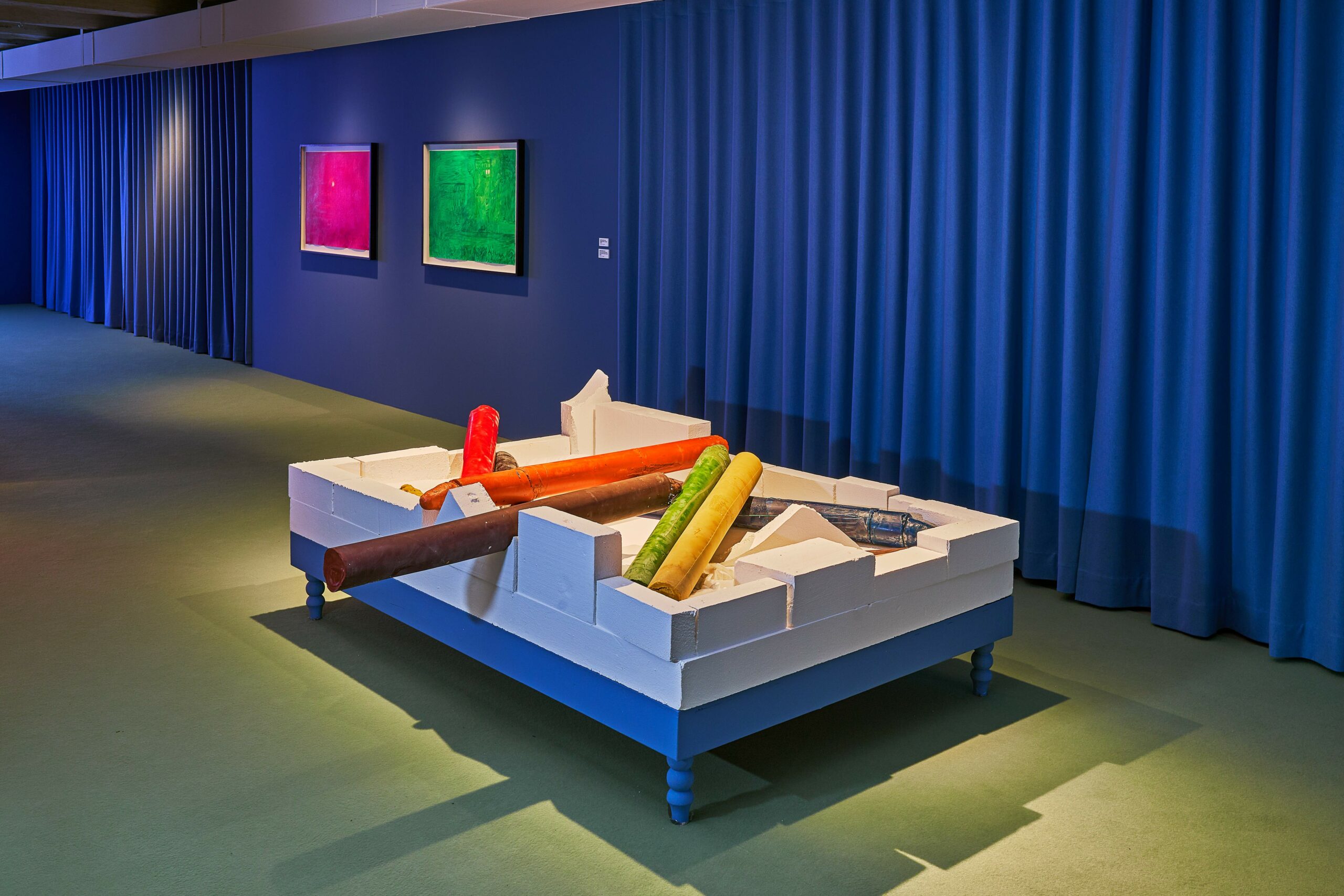
The trolls crayons, 2023-2026. Egill Saebjornsson. Photo, Chris Calmer
The exhibition is supported by the June 15th Foundation, the A.P. Møller Foundation, the Augustinus Foundation, the Axel Muusfeldts Foundation and the Danish National Art Foundation.
Book about Sigríður Björnsdóttir’s work: Ágústa Oddsdóttir: Art Can Heal. Published by König Books, Germany, 2023
The North Atlantic House: MY FRIEND THE ART — Egill Sæbjörnsson – more
The North Atlantic House: MY FRIEND THE ART — Egill Sæbjörnsson. Cover: Flower vases, 2021. Egill Saebjornsson. Photo, Chris Calmer
The North Atlantic House: MY FRIEND THE ART — Egill Sæbjörnsson is a review by Master of Science, Bo Christiansen, KULTURINFORMATION Redaktion: Jesper Hillestrøm